 Back
in the Wilderness: the Rough Places, Plain
Back
in the Wilderness: the Rough Places, Plain
Chokmah and Binah:
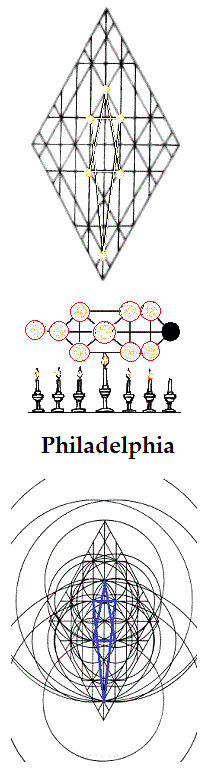
The Church at Philadelphia
Take my yoke upon thee, and learn of me.
And to the angel of the church in Philadelphia write; These things saith he that is holy, he that is true, he that hath the key of David, he that openeth and no man shutteth; and shutteth, and no man openeth; I know thy works: behold, I have set before thee an open door, and no man can shut it: for thou hast a little strength, and hast kept my word, and hast not denied my name.
Behold, I will make them of the synagogue of Satan, which say they are Jews, and are not, but do lie; behold, I will make them to come and worship before thy feet, and to know that I have loved thee. Because thou hast kept the word of my patience, I also will keep thee from the hour of temptation, which shall come upon all the world, to try them that dwell upon the earth. Behold, I come quickly: hold that fast which thou hast, that no man take thy crown.
Him that overcometh will I make a pillar in the temple of my Elohim, and he shall go no more out: and I will write upon him the name of my El, and the name of the city of my Elohim, which is the new Yahrushaliem, which cometh down out of heaven from my El: and I will write upon him my new name. He that hath an ear, let him hear what the Spirit saith unto the churches.
The street before him was covered with roses, lilies, flowers of every sort. Not many could see these quiet messengers of the Lotus: their hues held closely to the clear radiance of light, itself. But even those who could not see their loveliness might admit that the sky was particularly bright this morning-- as though the light slowed upon its destinations, hanging in the air like spring water frozen in tiny jars of flawless glass. Each step of his seemed to break the spell, sending silver slivers of ice light skittering along from around the soles of his feet to bruise the petals of the flowers, filling the air with precious aromas.
 And yet, it was quite an ordinary street. This block resembled a
boulevard; the next, an alleyway. Shops and empty tin cans, awnings and
lean-tos-- the passably ornate and the incidentally shabby blending
agreeably, unless one should be rude enough to inspect the scene more
closely than it deserved.
And yet, it was quite an ordinary street. This block resembled a
boulevard; the next, an alleyway. Shops and empty tin cans, awnings and
lean-tos-- the passably ornate and the incidentally shabby blending
agreeably, unless one should be rude enough to inspect the scene more
closely than it deserved.
He let the Spirit fill him to overflowing, that in its overflow he might become One according to its wisdom. Taller, he grew with each step; and smaller, also. A bend along the way brought him face to face with the morning sun, and his hands became as gloves; his feet, as shoes. His face had become as a window in a vast cloud of Spirit that filled the horizon as he walked, and from its happy opening shone forth the Light that exceeds all radiance. As he celebrated the presence of that Light within him in his walk, the force of his footfalls united the cells in his body with the meanings of the day.
He came upon a vendor in the way and felt suddenly tired.
Knowing the fatigue was not his own, he stopped beside the man and
bought a cake for his breakfast. When the peddler returned his change,
he thanked him for being considerate enough to supply him with his
breakfast so early in the morning.
As he busied himself with
preparing the cake to his liking, he could see that his host's spirits
had risen considerably already, and that a further supportive word would
not be without effect. As he prepared to take his leave, therefore, he
remarked that sleep is death to a sluggard; but to an industrious man,
it is health. The vendor smiled, and the monk reminded him that honest
smiles are rest to all men.
He finished his breakfast cake not
far along the road and began to feel some nausea. "It would be foolish,"
he thought, "to charge a vendor with so ready a smile with incompetence
or fraud in baking!" Deciding the cause of his discomfort must lie
elsewhere, the monk's attention fixed itself on a cantankerous old
fellow waiting impatiently along the edge of the road.
The man
was clearly upset. He was fussing back and forth along a treadmill of
his own making and was muttering incoherently of matters having no
apparent connection. He would stop abruptly and raise his arms,
fitfully, in a gesture apparently meaning, "Why me?" The monk noticed
that the man's arms never came above his waist.
Although the
cause of this discomfort was not apparent to the monk, he reasoned that
it would help but little to know. The man was no stranger to this mood,
it was clear; and knowing the particulars of this appearance would only
muddle perception of the whole. The man was bound by an incapacity for
forgiveness of faults and failures-- whether real or imagined-- to which
he had been subjected by his fellows over the years. If he was no longer
able to forgive, after not being forgiven for so long, the monk
reasoned, the man might profit from being forgiven for nothing! Why not?
It would cost him nothing. He would give the man a seed of forgiveness!
If the man could receive it, he would begin to mend.
As the monk
approached this aura of grumps and snaps and snarls in his resolve for
good, the angry man belched, looking somewhat bewildered. Immediately,
the monk's own stomach felt better, and he rejoiced in the knowledge
that the man was not beyond cure.
"Good morning to you, sir! I'm
so sorry to have kept you waiting so long! Forgive me if I should not be
here tomorrow, at this time. There are so many hours in the day, you
know; and every one of them must be filled with something. Remember me
to your family; and good day to you, sir!" As he passed on by, it was as
though a pack of wolves was at his heels; but the monk was content--
their fangs would clench harmlessly in the air of wonder.
As the
monk neared his destination, the wind brought to his hearing sounds of
pleasant laughter. He thought to pass on by-- his friends were waiting
just beyond, in the place where three roads meet; but he realized that
every perception given to him in his journey was a part of his path, and
that he would as foolishly ignore the apparently careless as those
clearly in need of help.
Deciding to heed this call also, he
found that the laughter came from a group of children playing a game of
marbles in the middle of the road. They were kneeling around a circle
they had drawn in the dust and were very absorbed with the positions of
the marbles within the circle. If he had not decided to stop, he might
easily have fallen over them.
"What a wonderful game you're
having," he exclaimed! "My heart is truly blessed by your laughter. So
many children, nowadays, take themselves so seriously! No doubt, it is
because of the gravity of old-timers like me! I want to thank you for
enriching my life by your joy. But my thanks will not come for nothing!
Tell me, if you will, the secret of your game."
The children
giggled somewhat at such a speech, but they were truly pleased by his
care of them. A furtive silence passed quickly around their circle and
seemed to settle on the smallest of them. The child got up from off his
knees and dusted off his trousers. Squinting up at the monk, he
answered, "No one wins."

| Laodicea | ||||
| Smyrna |
 |
Ephesus | ||
| Thyatira | Pergamos | |||
| Philadelphia | Sardis | |||
site map map |
book menu menu |
|||