|
|||||||||
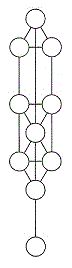
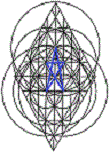
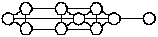
Adam Kadmon is the pattern upon which the Crown Diamond is built. Composed of straight lines, its
major intersections and points of termination are known as "sephiroth"-- as "brightnesses," literally, or as "spheres"
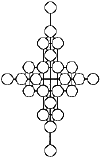
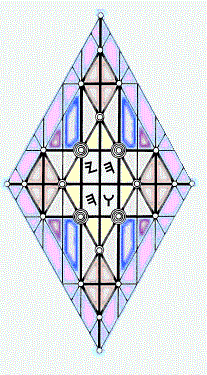
In the diagram's entirety then, the Crown Diamond is an image of the Merkava-- of the Chariot of Elohim, the vehicle of the Holy Breath; for the whole represents the unified, mystical Body of Yahushua, HaMashiyach. The open center formed by the overlaps-- by the court at the center of the four, interlocking Adam Kadmons-- is therefore understood to represent the Bosom of Avraham, in which is hidden the path leading through the diamond's center and on, beyond the breadth that extends above the heavenly throne of Yahushua, the Angel of the Presence, into the Realm of Pure Spirit (Rev. 3:21; John 1:18, 14:9-11, 16:28; Eccles. 12:7; 1 Kin. 8:27; 1 Tim. 6:16). As Angel of the Presence, Yahushua is the interface between God and created realms. These magnified aspects of the mystery will be a focus of the presentation on the Crown Diamond, itself.
As a symbol of the Logos-- of the Foundation Stone, the Cornerstone-- Adam Kadmon is defined as the spiritual projection of the Complete Adam
(1 Cor. 15:45-49). Since HaShem declares
through Yahushua
We have defined Adam Kadmon as the spiritual projection of the Complete Adam. It's understood, therefore, that the symbol speaks simultaneously of both the flesh and the spirit (Gen. 1:27; John 4:24). The beginning of its study, whether or not one is familiar with the symbol, involves discovery of the nature of Elohim through the creation parable of the flesh; and the fruition of its study is the knowledgeable, priestly sacrifice of the body's faculties to God's Spirit: to the end that every thought, word, and deed becomes a conscious offering to Ruach haElohim, the Breath of la (2 Cor. 10:5). Because the carnal mind in the isolation of error is enmity with God (Rom. 8:7), this study can be successfully undertaken only in the name-- in the spiritual position --of the true and faithful witness, Y'shúa (John 14:6), the man called the messiah (Matt. 1:16). The first Adam fell by allowing the flesh to predominate the Spirit, that he might accompany Eve in the eons of judgment that would come because of her deception by the reasonings of the carnal mind (Gen. 3:13; 1 Tim. 2:14). In partaking with Eve, Adam demonstrated perfection in the law of love (Rom. 13:10; John 15:13): he was willing to lose his life-- to invest it, in faith that he would ultimately aid in the redemption of the one sheep for which he was responsible (John 10:11; Amos 3:6-7).
The answer to the question by Elohim-- "What has thou done?"-- is not fully answered by Adam's words, "I did eat," nor even by the apostle Paul's words concerning the significance of Adam's decision. The answer has come by the littles through every word of scripture given unto man throughout the ages and, no doubt, beyond: unto the farthest reaches of eternity. Adam had sworn an oath, establishing covenant with bone of his bone and flesh of his flesh; and by honoring that agreement-- even against the faces of mortality: by agreeing to join Eve in the process that would lead to their "full extension" (a Hebrew concept of "death"), Adam and Eve became as sacrifices: the praiseworthy progenitors of all mankind. Before the separation of Eve from Adam, Adam walked with Elohim, thinking, "We are." He continued in that awareness upon awakening to Eve's separation, including in that mindset the additional thought, "Thou art also of us." In contrast, Eve was born to the thought, "Thou art; I am; we are; and God is." The dynamics of the Fall were therefore inherent in the processes of creation itself, in that Creation necessitated awareness of self: an awareness that, lingered upon, can be misconstrued as primacy of self, opening mankind to the logical basis for the error of pride, which comes by forgetfulness of unity within the isolation of individuality. The "Adversary" is that body of thought built by man in the blinking of an eye within the cocoon of reflective thought (Acts 17:30). Love of his own perfection, the sense of entitlement fostered by that perversion of self-awareness, became Lucifer's undoing. Learn what this means, "I will have mercy and not sacrifice"; for Satan, and the hosts of Amalek fathered by him in his ongoing conjunctions with man's perception of experience, will be bound in the fullness of time by Y'shúa's prayer, "that they may be One" (John 17:21). The Second Adam triumphed over the inner adversary (Matt. 4:1-11; Rev. 3:21; Col. 2:15) by reconciling the deceived (Eve, the uncircumcised) and the not deceived (the First Adam, the circumcised): by aligning the flesh in its fallen state with the redeeming will of the Spirit (Eph. 2:11-16; Col. 2:10-13). Y'shúa's earthly walk unto his own mortality in the triumph of his unity with Yahushua, the Angel of the Presence, assures the ultimate salvation of Eve, as the maligned First Adam is a figure of Messiah in Torah, and as Eve is a figure of his bride, the Church (Eph. 5:31-32; Rom. 7:14). United in the hidden faithfulness of the First Adam's death, they shall also be united in the faithfulness apparent in the Second Adam's messianic life (1 Cor. 15:22). Therefore, in the beginning of mankind's sojourns upon Earth-- before the impact of Eve's separation from Adam at her creation began to assert itself-- before awareness of its significance came by the fruit of the Fall, there was harmony between the flesh and the Spirit (Gen. 2:18, 25). A far greater harmony, magnified in understanding by Truth and in comprehension by Grace (Is. 42:21; Luke l: 46; John 1:17), is restored by Messiah Yahushua in answer to his voluntary sacrifice of self for the building of the inward Temple made without hands (Luke 12:50; Mk. 10:39; John 17). As, in the beginning, the Breath of Father hy hy emptied into the processes of creation as Yahushua for the expedience of the flesh [Rev. 13:8; Gen. 2:7; 1 Cor. 15:42-45 (verse 46, and following, speaks of the maturation of natural things, as we know that the Spirit predates and inhabits all that appears)], so the man called Mashiyach Y'shúa (Matt. 1:16) sacrificed his flesh to give witness of ImmanuAL's coming birth within all mankind (John 11:50-52; Eph. 2), calling upon everyone to take up their staves-- their crosses, their bodies and their lives-- and to follow in his steps according to his example.
We therefore conclude that the cross of Messiah-- like the sticks of Ephrayim and Yehudah in the hands of the prophet Yechezkel, a Son of Man-- encompasses the entire history of the human race, with the carnal legacy of the First Adam being crossed and canceled at every point in time by the awesome spiritual legacy of the Second Adam (Rom. 11:22-26), a legacy understood as the Complete, the Perfect Adam. In Adam Kadmon, then, are symbolized both the man of flesh and the man of Spirit. The sephiroth, or spheres, speak of specific locations and functions in the body as the Temple of ImmanuAL (2 Cor. 12); therefore, they also speak of the spiritual principles housed in the bodily forms and displayed by the bodily functions (Rom. 1:20). The connecting lines of Adam Kadmon are symbolic of the organization, coordination, and communication of the body's members and faculties. The courtyards delineated by the connecting lines symbolize the unity of operation of connected spheres. The united order of the whole, then, symbolizes the physical body of man and speaks metaphorically of the spiritual body of Yahushúa haMashiyach (Eph. 4:15-16). Because man is also symbolic of the organizational order of HaShem, in that man is made in his image and in that Mashiyach is his express image (Heb. 1:3), Adam Kadmon speaks also of the invisible reality of the Heavenly Father of Spirit: we reason because he reasons; we see because he sees; we are able to stand, to grasp, and to reproduce because these functions have their corollaries in the Realm of Pure Spirit (Col. 1:1). This is not to say that our thoughts are as his thoughts (Is. 55:8), nor that our members are as his members (Deut. 32:31), but that the forms and functions to which our souls have been united in this life are like prisms, enabling us to see the Light that shines within them from the Source as we are given ability through Grace. Yet further concerning things below, the Logos is the pattern of Creation, not merely of man (Rom. 1:20). Adam Kadmon, as symbol of the Logos (the Word), is therefore a key to the organization, structure, and spiritual significance of all things in the universe. As consequence, the sephiroth can be recognized and understood in every realm of investigation in every nominally secular sphere of human activity-- from speculative science to meal planning, whatever substantive difference there may be between them. Relentless scrutiny of man's endeavors discloses that the underlying reality of every assumption presumed as fact is faith. In the quantum understandings of modern science, therefore, all human activities are forms of religious practice; and all shall become clean as they turn to hwhy in Mashiyach (Acts 10). Though Adam Kadmon-- especially in its dimensions of extension in the Crown Diamond-- functions as an oracle concerning all things, it is not the means to understand all things. The Tree of Life is given to those who have overcome in and by the power of Messiah's Word: its fruit is lawful to those who have intimate, first-hand knowledge of. and are also reliant upon. the indwelling Spirit of hwhy . Those consciously led by God's Spirit are his children and need rely on no exterior teacher, prophet, or guide, having the confirmation of all these engraved upon their hearts by reason of the Rock upon which they stand (2 Cor. 3:3; 1 John 2:27). What, then, some may reasonably ask, is the reason we should study these symbols? For no more reason than we should study scripture (John 5:39), except that the wisdom of hwhy decreed these things for the benefit of his children, who are able to learn of his ways, only here (Dan. 7:1) a little, and there, there (Dan. 9:2) a little (Is. 28). There are no pressing needs in the walk according to the Spirit: he who believes will not make haste. Let us, then, proceed with frequent reference to scripture and with constant supplication to the Holy Breath that hides within our breathing, to see whether these things are so (Acts 17:11). Understanding that spiritual comprehension comes little by little (Dan. 9: 21-22), let us agree to take a closer look at Adam Kadmon, and at the wonderful Tree of Life it represents, to the glory of HaShem. |
|||||||||
| The Sephiroth | |||||||||
|
|||||||||
|
|||||||||




 or "emanations," traditionally.
The name is a cognate of the Hebrew word
or "emanations," traditionally.
The name is a cognate of the Hebrew word
 of the Logos--
of the "Word," its components are fully replicated in the Crown Diamond diagram four times
in a circular arrangement in which its upper portions overlap, one sphere upon another
of the Logos--
of the "Word," its components are fully replicated in the Crown Diamond diagram four times
in a circular arrangement in which its upper portions overlap, one sphere upon another
 that
he is the First, and also the Last: the First, and also
that
he is the First, and also the Last: the First, and also 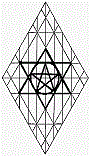
 Furthermore, as the fall of the
First Adam is an epic process whose continuing effects are yet evident both in the world at large and
also in the Church
Furthermore, as the fall of the
First Adam is an epic process whose continuing effects are yet evident both in the world at large and
also in the Church 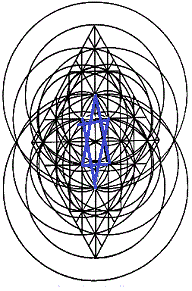 5.20; 1 Cor. 15:22, 26)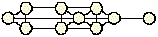

 map
map menu
menu